
Another Boenau who wrote: Inversion
Cluster B(ike) Activists frame the world in such as way that “people on bicycles” can never do any wrong in the presence of “drivers.”
This delusion not only distracts from the legal rights and duties of bicyclists as drivers of vehicles1 but is based on the oppressor/oppressed victim framework. Furthermore it seldom if ever allows for a grey area instead separating an issue into black and white. It’s an extension of Woke ideology, especially the progressive/left variety2 but instead centers roadway transportation choice as the central identity tenant.
Consider the case of the latest from Andy Boenau3 who wrote:
She’s at a red light, complaining about a temporary delay because of a social group ride. She gets a green light and chooses to drive into the people riding bikes.
This kind of antisocial behavior should result in loss of driving privileges.
As always, Boenau marries subtle truths with blatant lies.
It’s true the woman driving the car and is stopped at a red light. In the opposite direction on this four lane road with a center turn lane are dozens of bicyclists many of whom are unlawfully proceeding in the lanes intended for opposing-direction traffic or left turns. This is a “temporary delay” but unlike being behind bicyclists going in the same direction lawfully is an illegitimate reason for her delay. She doesn’t “drive into the people riding bikes,” she proceeds cautiously and despite her frustration remains calm in both her tone of voice and her driving.
She could arguably be cited in some jurisdictions for holding her phone (or camera) in her hand or for proceeding through the intersection, despite her green light. But several of the cyclists could similarly be cited for actually running the red light (yes, including in the few states which legalized such stops for bicyclists in certain conditions) and for riding in the incorrect lanes. Similarly at the end, the motorist in the black pickup truck could be cited as well for driving down the wrong side of the road.
Group size does not confer new rights. Being vulnerable does not nullify duty. Ignoring such realities does not make cycling safer, it instead makes it less credible in the eyes of society.
Naturally for social media, the replies are fairly sane.
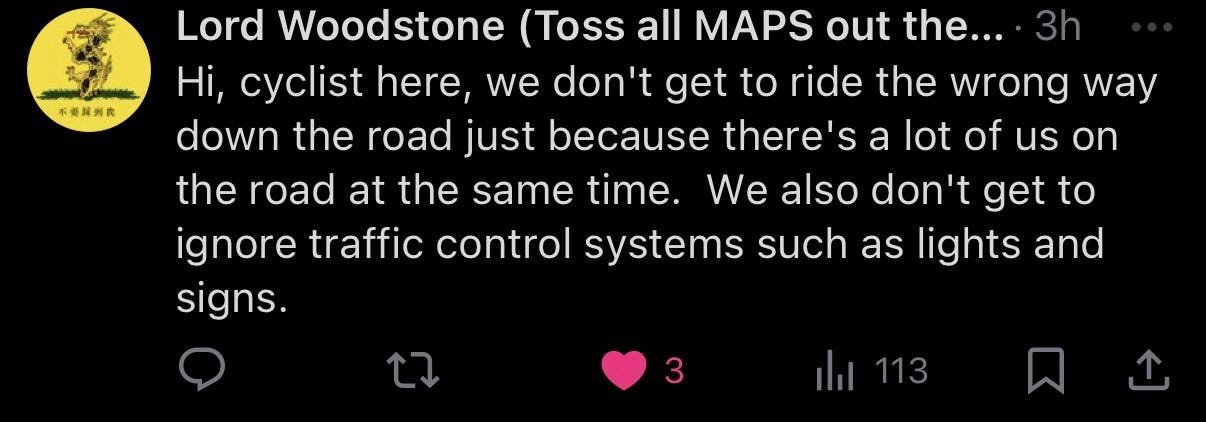
Several in the replies indicated they are motorists who do follow the rules of the road and ask that bicyclists do the same. Others were fellow bicyclists frustrated in the reputational damage shown in both the video and by Boenau’s Cluster B(ike) activist antics. Yet others conflated inanimate objects with their operators.
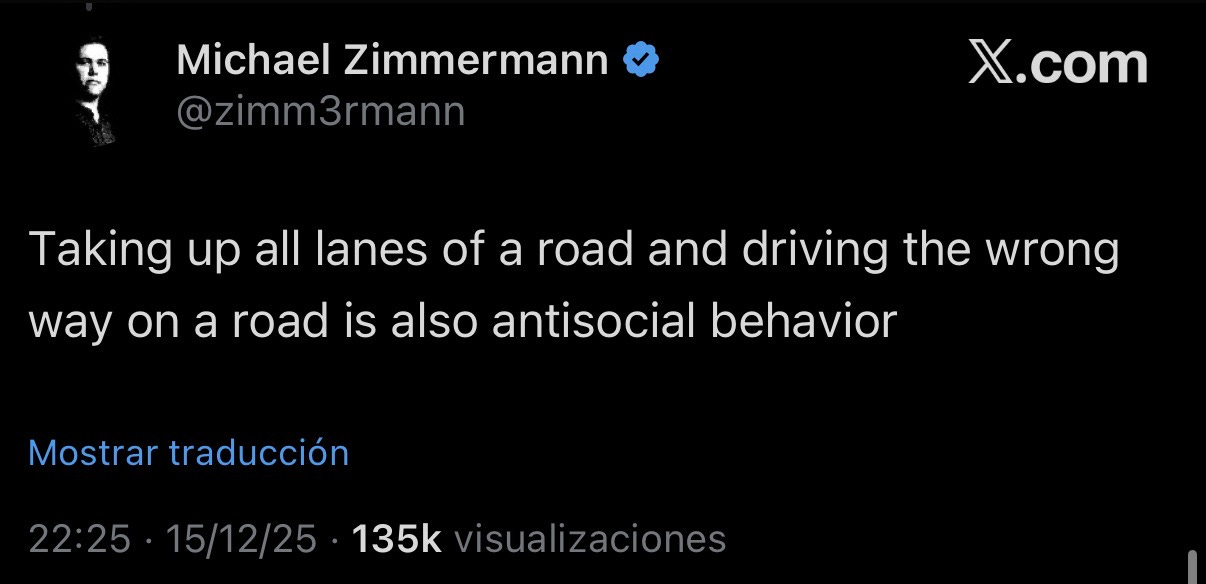
Beonau did, of course, did what he does best.
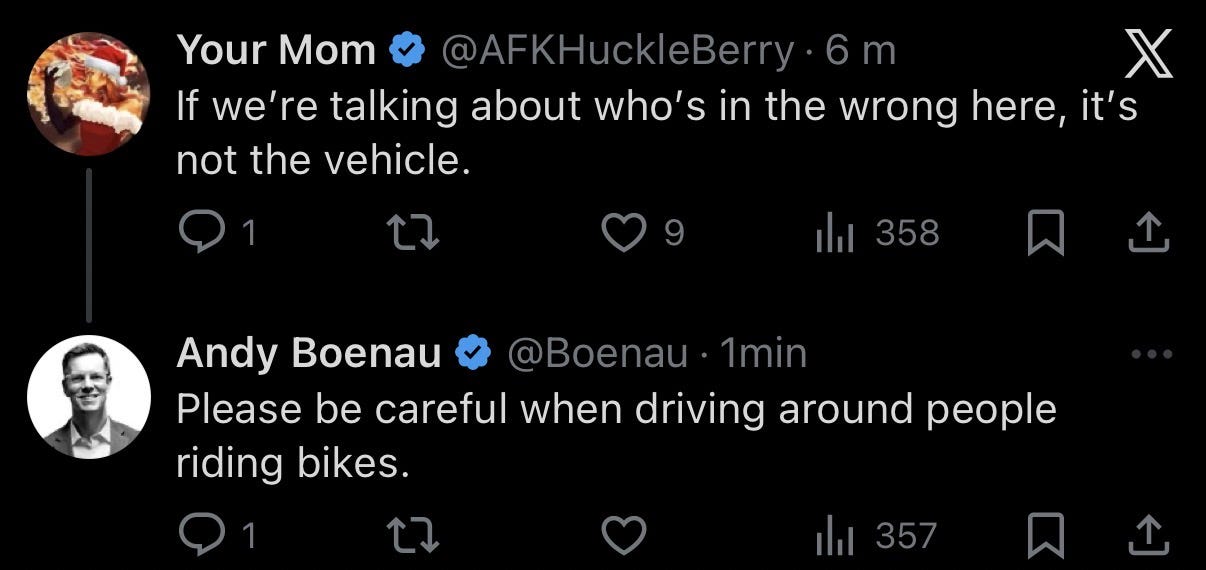
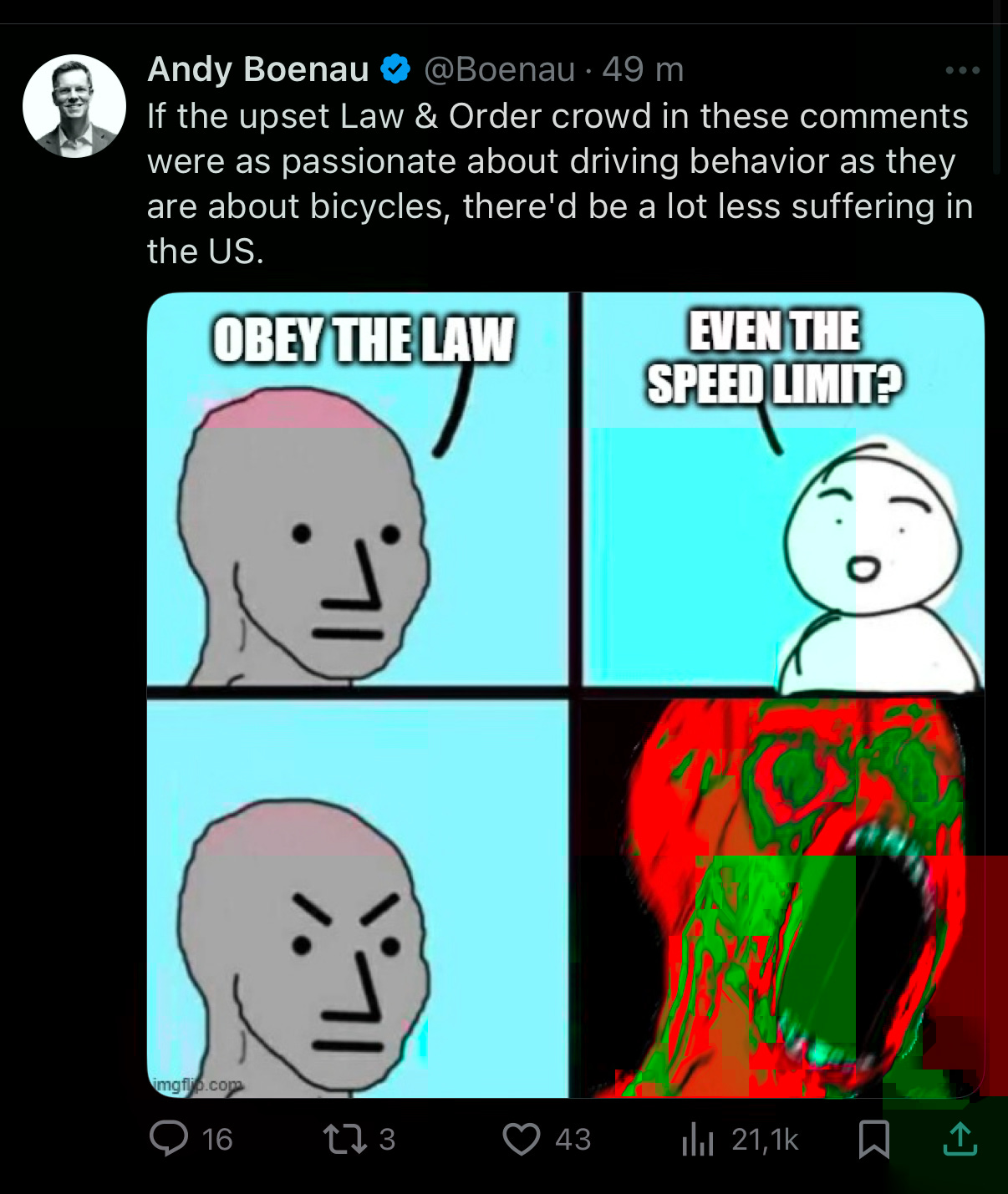
Boenau’s takes are not dangerous because they are merely wrong. They are dangerous because they normalize a way of thinking about public roads that is fundamentally hostile to the social contract that makes shared use possible. His tactics such as intent attribution without evidence, erasure of cyclist duties, escalation to punitive sanctions, and retreat into identity rhetoric when challenged—are not accidental excesses. They are the operating logic of a movement that is quietly stomping out the legitimate bicycling advocacy movement and abandons reciprocity in favor of moral exemption.
The protected-bike-lane, anti-car advocacy sphere increasingly treats the roadway not as a shared system governed by rules, but as contested moral territory. In this worldview, automobiles are not vehicles operated by fallible humans under a legal framework; they are symbols of oppression and their operators are perpetrators of “traffic violence.” Cyclists are not drivers of vehicles with agency and responsibility; they are a permanently innocent class who can do no wrong. Once that symbolic inversion takes hold, the rules of the road become negotiable, enforceable only against the out-group. Civility and predictability, which traffic systems require to function, is rebranded as submission.
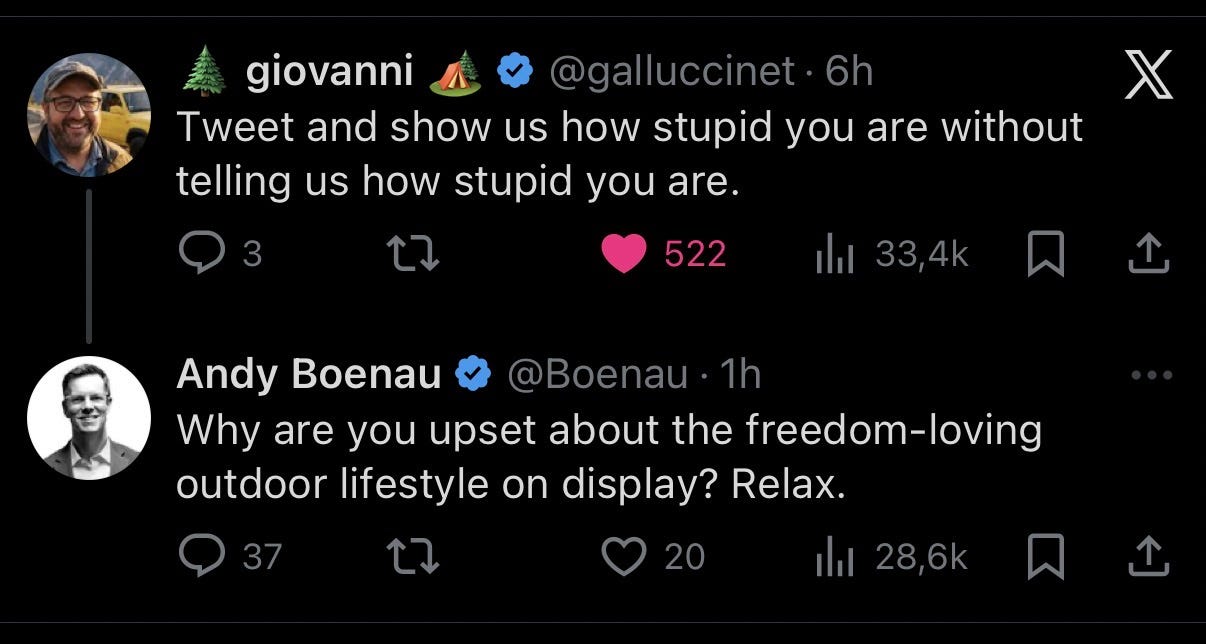
Boenau’s tweets are exemplary of this shift. He does not argue that the cyclists in question were operating lawfully, he doesn’t care. He does not ask whether group size confers special rights; he presumes it does. He does not acknowledge that riding against traffic or occupying opposing lanes destroys the very predictability cyclists depend on; he reframes objections as cultural intolerance toward a “freedom-loving lifestyle.” When confronted by other cyclists pointing out elementary traffic law, he does not correct himself. He dismisses them. That is not advocacy—it is boundary destruction and it’s textbook Cluster B personality defect behavior.
This matters because roads are not moral playgrounds. They are coordination systems. Every user—cyclist, motorist, pedestrian—relies on the expectation that others will behave in legible, rule-bound ways. When Cluster B(ike) activists publicly signal that rules apply selectively, they weaken that expectation for everyone and destroy the attempts at reputation building and education legitimate cyclists have been working on for decades. Law-abiding cyclists lose credibility and are lumped in with the Cluster B(ike) activists. Motorists lose patience and some become less open to understanding or obeying the laws themselves. Enforcement becomes arbitrary or adversarial. “Engineers” respond by hard-separating modes, not to empower cyclists, but to contain perceived disorder. The end result is not safety or freedom; it is fragmentation, resentment, and heavier state control.
Legitimate rules-of-the-road cyclists should recognize this for what it is: an existential threat to their standing as equal road users. The gains cyclists have historically made—legal recognition as drivers, the right to use general-purpose lanes, the expectation of equal treatment—were earned through insistence on competence, predictability, and shared duty. The “protected” lane, anti-car movement increasingly rejects those foundations. In their place it offers grievance, spectacle, and moral immunity. That trade is catastrophic.
Everyday motorists should be equally concerned too. A movement that openly treats traffic law as an expressive tool rather than a coordination mechanism will not stop at bikes. Once intent no longer matters, once outcomes are judged solely by identity, once punishment is demanded without due process, the logic expands. Today it is license revocation by tweet. Tomorrow it is automated enforcement, collective blame, and ever-shrinking discretion—all justified in the name of safety but untethered from actual behavior.
Public roads only work because of a fragile, often invisible agreement: everyone follows the same rules, even when it is inconvenient, because everyone benefits when others do the same. Boneau’s rhetoric—and the movement that cheers it—actively erodes that agreement. It teaches cyclists that duty is optional and motorists that restraint is a sucker’s game.
So the warning is simple and overdue. Not everyone who claims to speak for cyclists should be allowed to do so unchallenged. Not every call for “safety” is compatible with law, reciprocity, or freedom. And not every bike-lane advocate is advancing cycling. Some are dismantling the very norms that allow bicycles and cars to coexist at all.
If you care about functional roads—whether you drive a bicycle, drive an automobile, or do both—you should treat Cluster B(ike) activism not as a harmless annoyance, but as what it is: a direct threat to the shared rules that keep public space civil, navigable, and human.
Not to be confused with drivers of motor vehicles who have the same duties in terms of basic rules of movement but have additional duties that apply to both said drivers and motor vehicles.

Thank you for this post -- I say this as a cyclist. The "cyclists can never do anything wrong" crowd gives us a bad name.
The video was very disturbing. As a CSI, it does make angry that those riders think they are promoting cycling. And I am fed up with the advocacy that promotes that type of behavior and infrastructure that marginalizes and segregates and makes cyclists "less than" road users. Thank you for this article. It's a gem.